
Unpacking Buffalo's offseason
The Sabres lost a couple of big names, but they made the most of their situation

After raising expectations by breaking a 14-year playoff drought and nearly making it to the conference finals, the Buffalo Sabres have had an odd offseason. Not bad, not great, just odd.
After raising everyone’s expectations following a year to remember, the Sabres, as it currently stands, are bringing back the same team as last year, just without a couple of pieces. But with enough internal improvement, the Sabres should be fine, and they did a decent job turning losses into wins.
Buffalo’s offseason has been defined by departures instead of additions, which is a little unusual for a team entering its competitive window. But Buffalo clearly didn’t see expiring free agent Alex Tuch, who is one of the league’s better five-on-five scorers but also just turned 30, as a $10.5 million player going forward, and the Sabres were already a bit limited in terms of cap space. Thus, they sent him to Washington for a third-round pick in a sign-and-trade.
Getting a third-round pick for a player who wasn’t going to stay is a win for the Sabres, but losing Tuch will sting. Tuch was third on the team in Hockey Stats’ WAR metric and led Buffalo’s regulars in points per 60 minutes at five-on-five. Not wanting to pay a 30-year-old that kind of money as your window opens makes sense. While he can drive play a bit, a lot of Tuch’s value is in his shot. If that falls off as he ages — a distinct possibility — that contract could quickly turn into an albatross. But just because it makes sense for Buffalo to move on doesn’t mean Tuch won’t be hard to replace.
Similarly, Buffalo shipped out a couple of defensemen. Michael Kesselring, who was supposed to be the centerpiece of the J.J. Peterka trade a year ago, never really fit in in Buffalo. The Sabres leveraged their surplus of defensemen by shipping Kesselring to San Jose and moving up seven spots in the first round of this year’s draft in the process. That’s a tidy piece of business for both sides, and the Sabres used that pick to select forward Ilia Morozov, who probably wouldn’t have fallen to Buffalo’s original pick at 27.
However, the Sabres’ biggest move came before the draft when they traded defenseman Bowen Byram for a haul that included the fourth overall pick. A Byram trade had been rumored since last summer, and it was clear Byram wanted to be somewhere he could be The Guy, something that simply couldn’t happen on a Buffalo team that had two defensemen who were No. 1 overall picks in Rasmus Dahlin and Owen Power.
To call this “tidy business” again would be an understatement. Calling this a coup would be an understatement. In no world is Byram worth the fourth overall pick, let alone that selection plus defenseman Louis Crevier and the 45th pick.
Byram is a hard player to evaluate. He’s a toolsy player — there’s a reason why he was the fourth overall pick in 2019. Looking at Corey Sznajder’s All Three Zones data, he can move the puck well, even if he isn’t exactly the most dangerous player in the offensive zone. Byram being able to play on either side is also a huge plus.
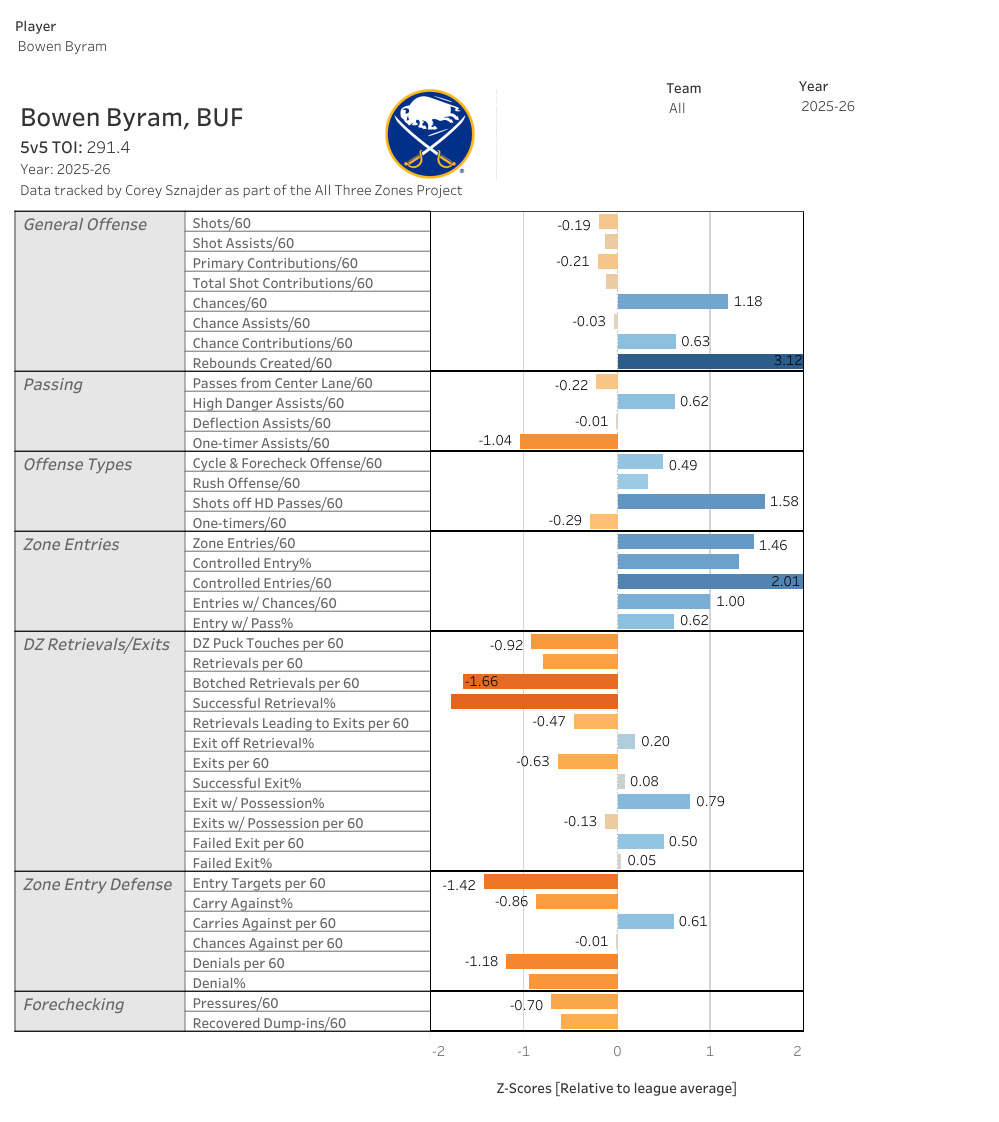
One problem: Byram’s underlying numbers aren’t great. Among all defensemen last year, Byram was 97th in Hockey Stats’ WAR metric last year. He’s never been a positive in Evolving-Hockey’s RelTM xG plus/minus metric, meaning his teams are worse with him on the ice than on in terms of expected goals. Byram does rank 22nd among defensemen in points per 60 minutes at five-on-five the last two seasons, though he’s also benefitted from a high-scoring environment in Buffalo, as the Sabres have the second-highest shooting percentage at five-on-five in that span. At a certain point, it’s Billy Beane from Moneyball going, “If this guy is so good, why doesn’t he play good?”
To recap, the Buffalo Sabres were a goal away from reaching the conference finals last year, dealt a player that doesn’t really drive play and ended up with the fourth overall pick. Buffalo used that pick to select defenseman Daxon Rudolph, which raised some eyebrows. But he certainly has the scoring profile of a star defenseman, and the Sabres added yet another high-potential young player.
Buffalo also took the second-round pick it received from Chicago in the trade and sent it to Anaheim for defenseman Olen Zellweger. At 5-foot-10, Zellweger is undersized, but he played really well for Anaheim last season in a somewhat sheltered role. He has his defensive warts, but he moves the puck well and brings some offensive punch.
After a rough start to his career, Zellweger’s underlying numbers greatly improved last year, and it wouldn’t be a surprise to see him take another step forward on a team that has more structure defensively. Buffalo replaced Byram with a younger defenseman that has more upside and can drive play. Plus, Zellweger only costs just over $3 million the next three years, while Chicago made Byram the highest-paid defenseman in the league at $12.5 million starting in 2027-28. It wouldn’t be a surprise to see Zellweger be just as effective for far less money.
Buffalo is essentially hitting the reset button while setting itself up for something better down the line. The Sabres didn’t exactly replace Tuch, but they’re hoping to make up for that loss with some internal improvement from their young core.
Zach Benson has turned into a legitimate top-six option, and, at just 21 years old, it feels like he has another level he can reach. Josh Doan enjoyed a nice breakout year last year, and he’s just 24. Konsta Helenius was a real difference maker in a small sample size of games in the regular season and the playoffs. Noah Ostlund established himself as a full-time NHLer last season and should have more opportunity this year. Buffalo should also have Jiri Kulich back in the fold after missing most of last season with a blood clot.
There are still some loose ends for the Sabres, like if they’re going to roll with Ukko-Pekka Luukkonen again between the pipes or what things will look like down the middle. But even after losing Tuch and Byram, Buffalo should still be in a good position to prove that last year’s run wasn’t a one-time thing.
All stats are from Hockey Stats unless otherwise noted.