
Remember a Guy: Carl Hagelin
The perfect complementary player for a contender

It’s August, and October still feels like a long way away. To pass the time until the puck drops on the season, I will be clicking on the Remember Some Guys button on hockeyviz.com until somebody interesting pops up. Here’s today’s edition.
Carl Hagelin had pretty much the best possible career arc for a player who wasn’t a star: made the NHL despite being a sixth-round pick, was a beloved player in New York, became an integral part of arguably the most famous third line in recent memory as part of a Penguins team that won back-to-back Stanley Cups and hung around for a few more years until an eye injury forced him into retirement. With 296 points in 713 games, Hagelin didn’t have outstanding production, but he was a consistent play driver who was a perfect complementary piece to a contender.
Hagelin was selected by the New York Rangers with the 168th overall pick in the 2007 NHL Draft. Hagelin spent the next four seasons at the University of Michigan and helped lead the Wolverines to the championship game in his final season in 2011. Hagelin would sign with the Rangers and make his NHL debut in the 2011-12 season.
Again, Hagelin was never known for his outstanding offensive production, and he’d receive very little power play time throughout his career. But he was a decent scorer at five-on-five whose underlying numbers suggested he was a better player than his point total would suggest.
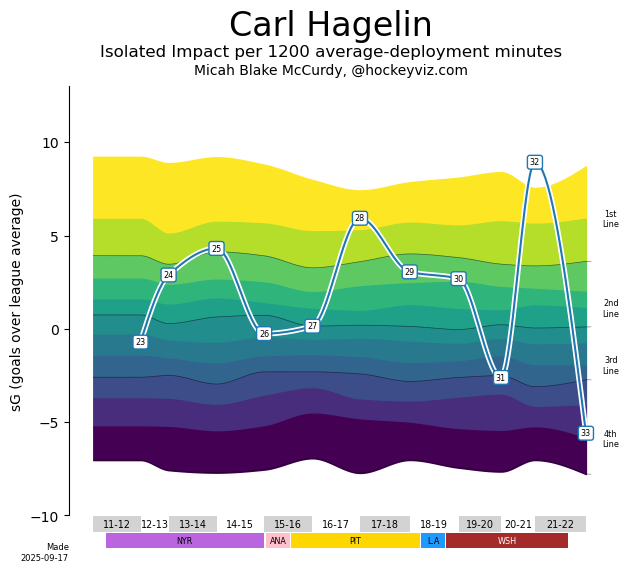
During his time with the Rangers, Hagelin was often a complementary player to much more renowned players, like Marian Gaborik, Brad Richards, Derek Stepan and Ryan Callahan. But those lines won their minutes, and Hagelin made them better. During the 2012-13 season, for example, the Rangers’ line of Hagelin, Stepan and Callahan posted a 68.8 percent expected goals share while outscoring opponents 8-2 in 170 minutes of work. That 68.8 percent expected goals share was the second-best in the league that year among lines with at least 100 minutes together.
But after a 35-point season in 2014-15, Hagelin was on the move. His contract was up, and the Rangers simply couldn’t afford to keep him. They shipped him off to Anaheim, and the Ducks paid him what the Rangers couldn’t: $4 million per year for four years.
Hagelin’s tenure in Orange County didn’t last long. With 12 points in 43 games, Hagelin just wasn’t a great fit. Thus, the Ducks and the Penguins swapped struggling players in January of 2016. The Penguins trading a first-round pick in the legendary 2015 NHL Draft for David Perron didn’t work out, so they sent him to Anaheim in exchange for Hagelin, who turned out to be a perfect fit in Pittsburgh.
Hagelin was more than just a little snakebitten in Anaheim, finishing his time there with a sub-five percent on-ice shooting percentage at five-on-five. However, Hagelin regressed to the mean pretty quickly in Pittsburgh, scoring 27 points in 37 games to close out the year. Hagelin’s speed was a perfect match for a Pittsburgh squad that wanted to play fast. Just like in New York, you could throw Hagelin in with Evgeni Malkin, and he’d keep up.
The Penguins had been competitive for years, but they just couldn’t put it together in the playoffs after winning a Stanley Cup in 2009. In addition to Marc-Andre Fleury’s meltdowns in the playoffs, Pittsburgh’s big problem was that its bottom six was abysmal. They had too many Joe Vitales, Tanner Glasses and Craig Adamses and not enough guys who could at least hold their own while 87 and 71 were off the ice. For example, during the 2013-14 season, the Penguins had a 43.6 percent expected goals share without Crosby and Malkin.
That changed in 2015-16, thanks in part to Hagelin. The Penguins came into the season with high expectations after trading for Phil Kessel in the summer, but they got off to a disappointing start before firing head coach Mike Johnston in mid-December. That was the beginning of a midseason retool, which included adding Hagelin. While Hagelin’s initial line with Malkin and Kessel dominated its minutes, the real game-changer came a little later.
Down the stretch and heading into the playoffs, Hagelin and Kessel formed a tight-knit line with Nick Bonino, forming what would be known as the HBK Line. The Penguins had the best expected goals share and the best actual goals share after New Year’s Day, so it’d be pretty hard to have bad underlying numbers on a team like that. But what set the HBK Line apart from everyone else was that it had someone of Kessel’s caliber on it and that it was the third line. With Crosby, Malkin and Kessel all on separate lines, the Penguins were a matchup nightmare.
In 144 minutes together in the regular season, the HBK Line had 61.1 percent of the expected goals with a plus-nine goal differential. That line continued to fire on all cylinders in the playoffs. The Penguins were steamrolling teams in terms of possession no matter who was on the ice, but there was a clear difference when the HBK Line was out there. That line outscored its opponents 15-9 in the playoffs, while the Penguins were breakeven in goals when the HBK Line was off the ice at five-on-five.
Whenever the Penguins needed a big goal, the HBK Line was usually the one that provided it. Hagelin scored the Penguins’ first goal in a Game 5 win to eliminate the Rangers in the first round, plus three more in the second round against the Capitals. One of those came in a series-clinching win in Game 6 where Hagelin had three points, including an assist on the series-winning goal.
The Penguins would go on to win the Stanley Cup and exorcise some demons along the way. While it was only seven years between championships, seven years is a long time when you have Sidney Crosby and are expected to contend every year.
The following year, Hagelin was limited to 61 games, and his 21 points were a career-low up to that point. The underlying numbers were still fine, but Hagelin wouldn’t be able to buy a goal from here on out. Between 2016-17 and his final NHL season in 2021-22, Hagelin would score 22.1 goals below expected, the ninth-worst mark in the league in that span.
But on a happier note, the Penguins were still really good. Hagelin wouldn’t play in the playoffs until the second round but continued to be an effective player despite meager production in the playoffs. The HBK Line was split up after a brutal run in the regular season (43.4 percent of the expected goals, minus-3 goal differential), and the Penguins suffered too many injuries to have any sort of continuity in lines throughout the 2017 postseason. But Pittsburgh found a way to win another Stanley Cup, and that run was capped off with a Hagelin empty-net goal in the final game.
Hagelin would stick around in Pittsburgh for another season before being dealt to Los Angeles during the 2018-19 season. His tenure with the Kings was short-lived, as he was traded to the Capitals three months later. Washington had an odd tendency to target former Penguins, with Justin Schultz, Daniel Sprong and Conor Sheary also all ending up in Capitals jerseys in the years following the Penguins’ back-to-back Stanley Cups.
Hagelin would spend three more years in Washington doing what he was best at: being an effective depth forward for a contender. He’d be sidelined by hip injuries, but he ultimately retired in 2023 due to a freak eye injury. It was an anti-climactic ending to an otherwise successful career, but Hagelin left a mark on the teams he played for.
All stats are from Hockey Stats.
I actually got to meet Hagelin during his short-lived Ducks tenure. I was sad to see him go, but Perron did perform well after the trade.