
Mikael Granlund and point compilers
How points can struggle to capture a player's value

Entering the 2023-24 NHL season, Mikael Granlund was in a pretty unenviable position.
He had just endured his worst season in terms of points in a season not shortened by COVID-19 since 2014-15, was traded at the deadline to Pittsburgh before earning the ire of Yinzers amid the Penguins missing the playoffs for the first time since 2006 and getting dealt again in the summer, this time to San Jose as part of the return for star defenseman Erik Karlsson.
A year later, Granlund has 84 points in 92 games in teal, including 24 in 23 games this season. Not too shabby for a player who was essentially a cap dump to make the money work in the Karlsson trade. But is his uptick in production an actual resurgence, or is it a byproduct of his usage?
Efficiency or volume?
Raw point totals can be a bit misleading. Just going to NHL.com and sorting by points doesn’t tell you how many minutes a night someone is playing, how much power play time they play or who they’re playing with. Granlund is an interesting case study here.
Since the start of last season, Granlund is 70th in total points, which feels like a small miracle given the lack of quality around him last year on one of the worst teams in the salary cap era. But a deeper look shows that there might not be as much value there as it seems.
For one, Granlund plays an exorbitantly high number of minutes. He’s logged over 21 minutes per game so far this season, which puts him ninth in the league among forwards. He’s played more minutes per game than Connor McDavid, Auston Matthews, Jack Eichel and Sidney Crosby. Granlund played a similar number of minutes per game last season (20:58) as well. Even on a terrible Sharks team both this year and last year, an NHL-caliber player who continues to receive such high minutes will score at a pretty decent clip.
Sure, Granlund has as many points as, say, Brock Boeser since the start of last season in roughly the same number of games. But Granlund is also playing over two-and-a-half more minutes a night. That adds up pretty quickly over an 82-game season.
For another, Granlund also receives a lot of power play time. His top two seasons in power play minutes per game have both come in San Jose so far. More power play time should lead to more points (also known as the Nikolaj Ehlers conundrum).
Granlund has scored 31 points with the man advantage since joining the Sharks. There’s nothing wrong with power play production — all goals count the same, after all — but it’s worth noting.
But no matter how you slice it, Granlund’s production is tied more to volume than efficiency. Of his 24 points this season, nine have come at five-on-five. In a similar vein, 29 of his 60 points last season were at five-on-five. Even by Granlund’s standards, he hasn’t exactly scored at a high rate at five-on-five during his time in teal.
That’s also true when looking at Granlund’s production rates compared to the rest of the team. At five-on-five, he’s fifth on the team in points per 60 minutes, being outpaced by Nico Sturm, Macklin Celebrini, Fabian Zetterlund and Luke Kunin.
The other issue for Granlund is that he struggles defensively. Look, the defensive numbers in San Jose for pretty much everybody not named Jake Walman or Alex Wennberg are terrible, but Granlund’s are worth noting because of how much he plays. His expected goals against per 60 at five-on-five (3.28) are the third-worst on the Sharks out of players with at least 110 minutes, just ahead of Mario Ferraro and Sturm, per Natural Stat Trick. Getting outscored 18-13 at five-on-five thus far hasn’t helped, either.
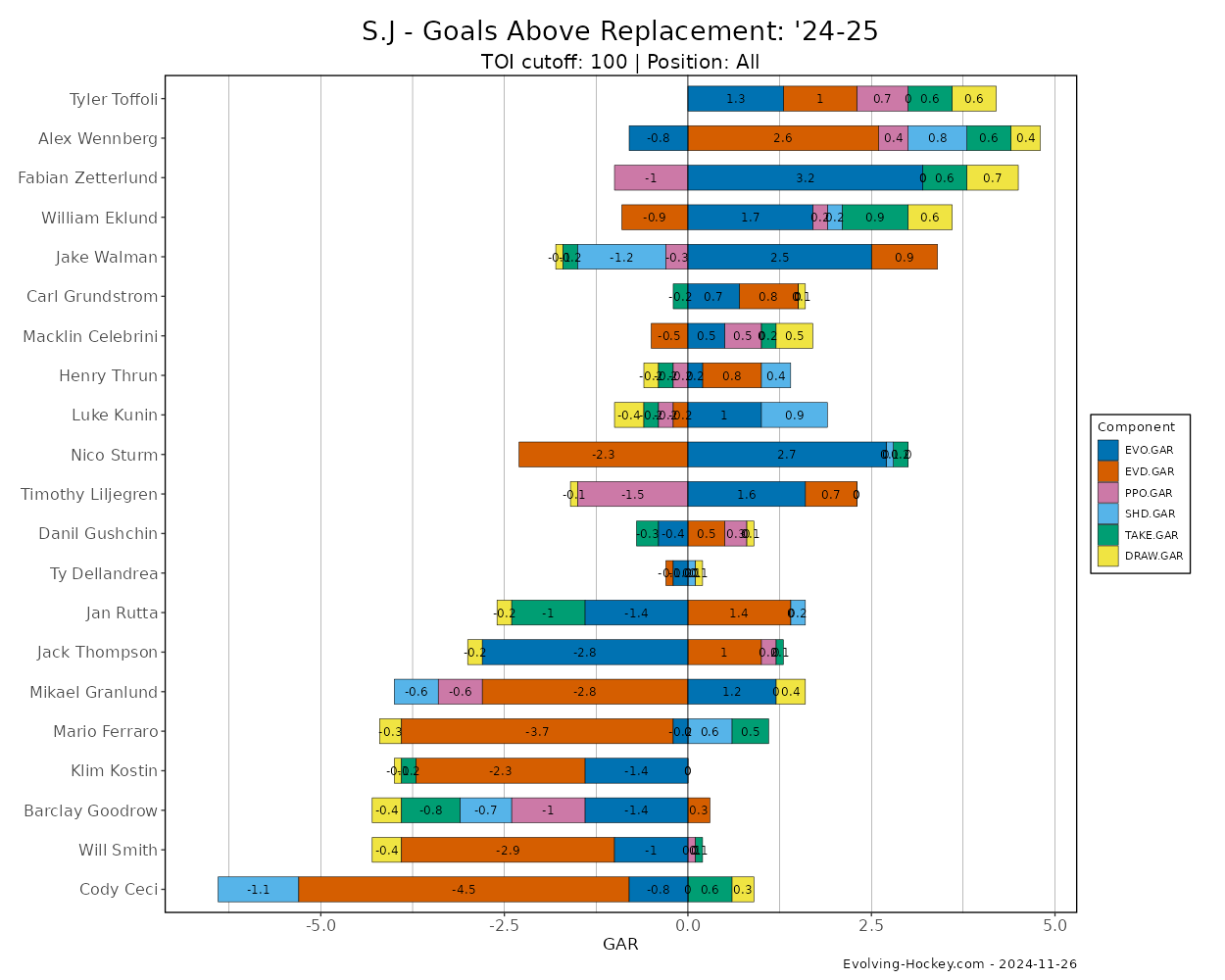
A lot of eye tests can sometimes hand-wave away defensive shortcomings with saying that it’s outweighed by a player’s play at the other end. Evolving-Hockey’s Standing Points Above Replacement models are mixed on Granlund’s time in teal, with him being below replacement level this season after finishing last year worth 1.7 SPAR. It’s pretty easy to pick out his defensive impacts here so far.
The positives
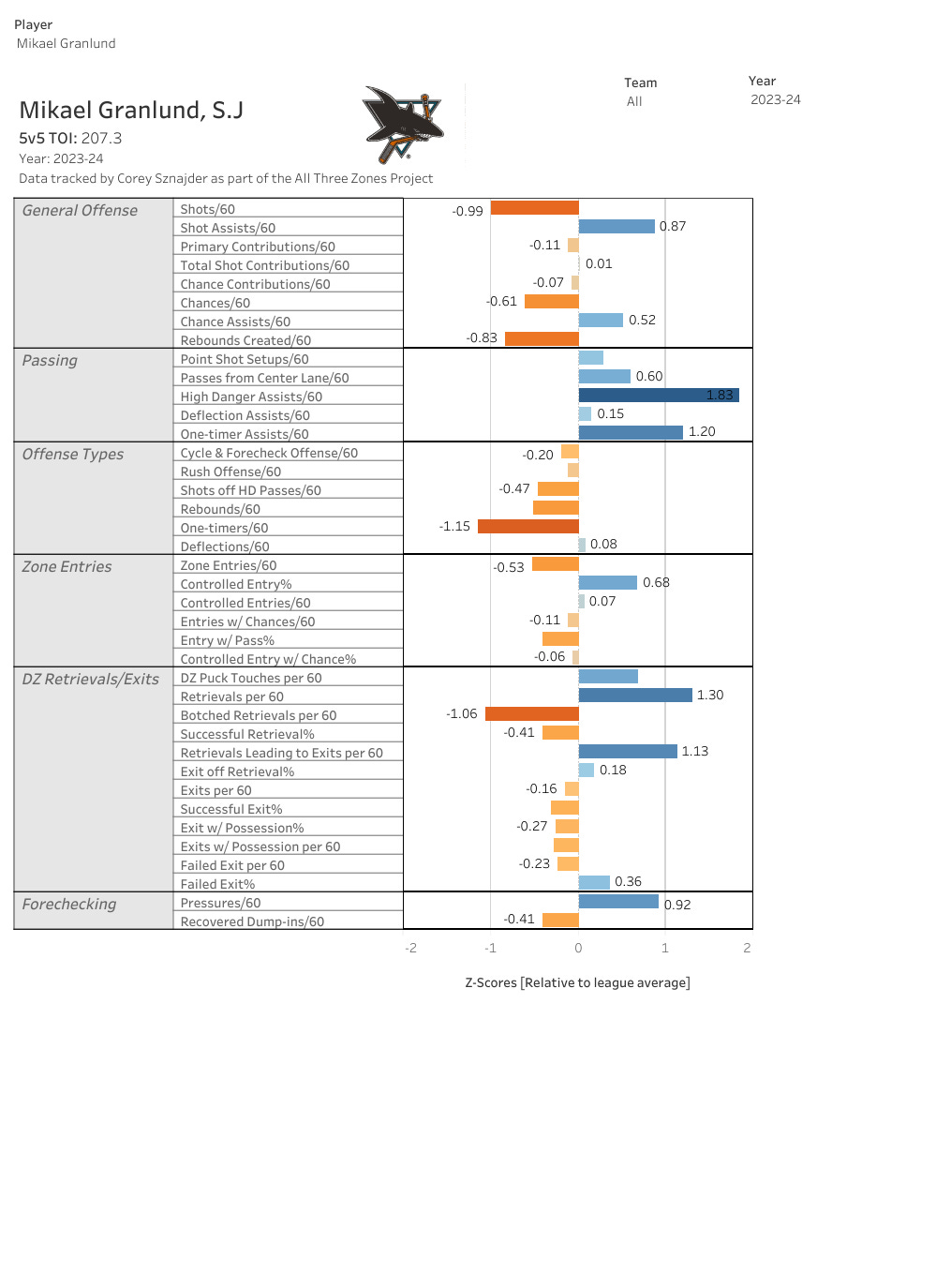
Granlund does, however, bring a few things to the table, namely his passing. Last year’s Sharks, among many, many shortcomings, lacked any kind of playmaking ability outside of him, Tomas Hertl and Eklund. Regardless of the situation, it’s pretty difficult to be on pace to surpass 50 assists like he was last season without having some kind of talent at passing the puck.
That skillset was pushed to the extreme last year, looking at his player card from Corey Sznajder of All Three Zones.
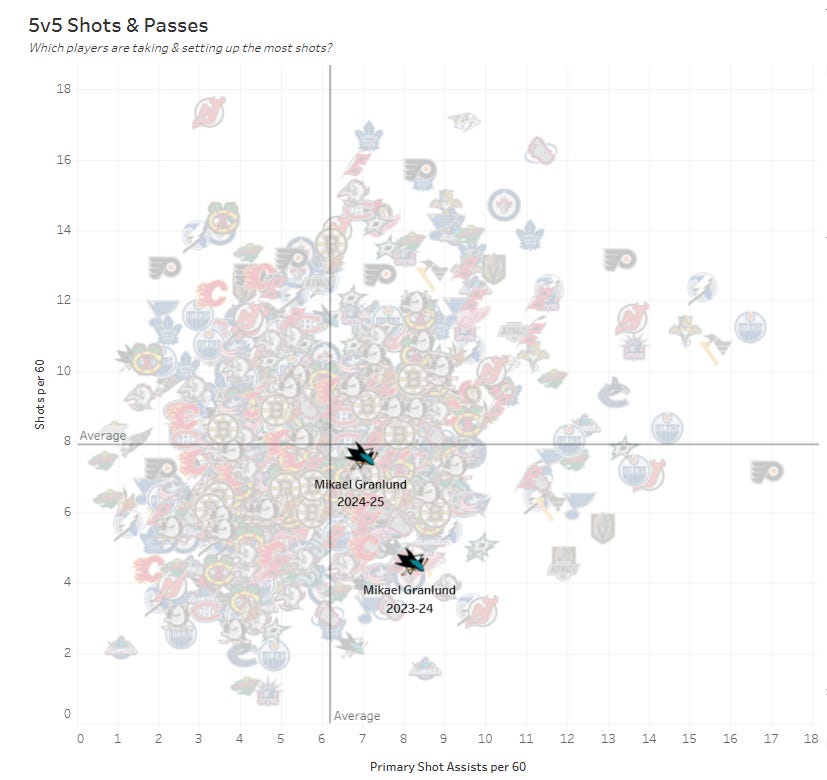
The big change for Granlund this year is he’s shooting the puck more and perhaps passing a little less. He’s already more than halfway to surpassing last year’s 134 shots on goal and is on pace to smash his previous high of 193. With nine goals on the season so far, he’s also on pace to easily exceed last year’s 12. You can see that here, again courtesy of Corey Sznajder of All Three Zones.
It’s especially clear on the power play. He leads the team in power play shot attempts, and his 27.2 shot attempts per 60 minutes with the man advantage is by far and away the most in his career.
Granlund isn’t dominant in his minutes at five-on-five, though nobody in San Jose is. He sports a 45.5% xGF% at five-on-five and is also losing the shot-share battle. He is, however, one of the Sharks’ best offensive players, even if he gives a lot back in his defensive end.
Per Natural Stat Trick, the Sharks produce 2.73 expected goals per 60 minutes at five-on-five with him on the ice, which would put San Jose in the upper third in the league. Without him, that number drops to 2.06, which would only be ahead of Detroit. That 2.73 number with him on the ice is also one of the highest marks in his career.
It’s probably too early to say whether or not Granlund having more of a shoot-first mentality is directly driving more offense for him and the Sharks this season. But he has definitely benefitted from playing with better teammates this year.
Granlund’s most common linemates at five-on-five last year were Fabian Zetterlund, Anthony Duclair and William Eklund. This year, he’s played the most with Tyler Toffoli and an Eklund with a full year of NHL experience under his belt. Not only has that three won the expected goals battle (56.2%), per Evolving-Hockey, but it’s the only line combo for San Jose to do so with at least 40 minutes together. They’ve been a bit unlucky to get outscored 8-4 during those minutes, thanks to a sub-6% shooting percentage.
Toffoli is the Sharks’ best driver of offense by several metrics, and his impact during Granlund’s minutes is certainly felt.
Once again, on/off-ice splits can be a little messier than “Player X does better away from Player Y, therefore, Player X is better,” but the difference between Granlund with Toffoli and without so far is pretty stark. Toffoli has been stellar by San Jose’s standards regardless of whom he’s playing with, but that’s not quite true for Granlund.
When the two play together, despite playing a high-event style at both ends, they’re fine. But without Toffoli, Granlund’s xGF% dips to 40.09%, which is actually slightly worse than how the Sharks do without both of them. Granlund’s offense also drops off a cliff, decreasing from 3.12 xGF/60 with Toffoli to 2.33 without. Toffoli’s drops to 2.46 without Granlund, but his defensive numbers improve by about the same amount to keep him around the 50% xGF% mark.
Wrapping things up
A lot of Granlund’s perceived value comes from the point totals. Does he bring a fair amount to the table offensively? Yes. Does he give back a lot defensively? Also yes. Does he live up to the point-per-game billing? Probably not.
But that works to the Sharks’ advantage, should they want to go down that path. His contract is up at the end of the year, meaning he’d be ideal trade bait come the trade deadline. Granlund’s actually fifth on The Athletic’s trade board already. The Sharks have some pieces on expiring deals that would fit what NHL general managers tend to target at the deadline, like Nico Sturm, Cody Ceci and Luke Kunin, but Granlund’s likely to be the one to bring in a haul given his production and position.
As Celebrini, Will Smith and the armada of Sharks prospects behind them mature and grow more accustomed to the NHL, the need for someone like Granlund to play 20 minutes a night should decrease. At that point, you might be paying someone for the role they previously played, not what they’re going to play.
A lot of the keep-or-trade debate about Granlund depends on the terms. But paying up for soon-to-be 33-year-old whose play-driving abilities are already a bit of a debate might not exactly be the greatest idea, even with San Jose’s deep pockets.